
Advised to have thyroid surgery — a nodule treated without an operation
A woman in Nairobi had been told she needed the left side of her thyroid removed for a large benign nodule. She chose radiofrequency ablation (RFA) instead. One month later the visible neck swelling had gone, her pressure symptoms had resolved, and an ultrasound confirmed a 54% reduction in the nodule — with no surgery and no scar.
“Do I really need surgery for this?”
When thyroid surgery is recommended, it is not always the only option. For selected patients with a confirmed benign thyroid nodule — particularly those with pressure symptoms, a visible neck swelling or cosmetic concern — a minimally invasive treatment such as radiofrequency ablation (RFA) can shrink the nodule while preserving the thyroid gland and avoiding open surgery.
This patient had already been reviewed at several clinics around Nairobi and advised to undergo a partial thyroidectomy — removal of the left thyroid lobe. She was reluctant to have an operation. She had first noticed the swelling about six months earlier; she had no difficulty swallowing and no hoarseness, but was starting to feel mild pressure, especially when lying down. A detailed thyroid ultrasound showed a large nodule that had effectively replaced the left lobe, with significant blood flow around it and a volume of about 19 mL — enough to explain both the swelling and the pressure.
Her journey at a glance
- 9 June 2026 — First consultation — seeking an alternative to a partial thyroidectomy.
- 27 June 2026 — Core needle biopsy confirmed the nodule was benign.
- 25 July 2026 — Radiofrequency ablation performed successfully under local anaesthetic.
- 28 August 2026 — One-month review: visible swelling gone, pressure symptoms resolved, 54% volume reduction.
- Next step — Further ultrasound follow-up scheduled at three months.
Why we didn't go straight to RFA
RFA is used for appropriately selected benign nodules — never simply as a substitute for surgery without proper assessment. So before any treatment, we confirmed the diagnosis.
Step 1 · Confirm it's benign
A core needle biopsy on 27 June obtained enough tissue to establish that the nodule was benign and that RFA was appropriate.
Step 2 · Check suitability
We reviewed the ultrasound characteristics, her symptoms and her thyroid function together — confirming the nodule was suitable for thermal ablation rather than surgery.
Step 3 · Plan the treatment
With a benign diagnosis and a suitable nodule, she proceeded to treatment planning for radiofrequency ablation in Nairobi.
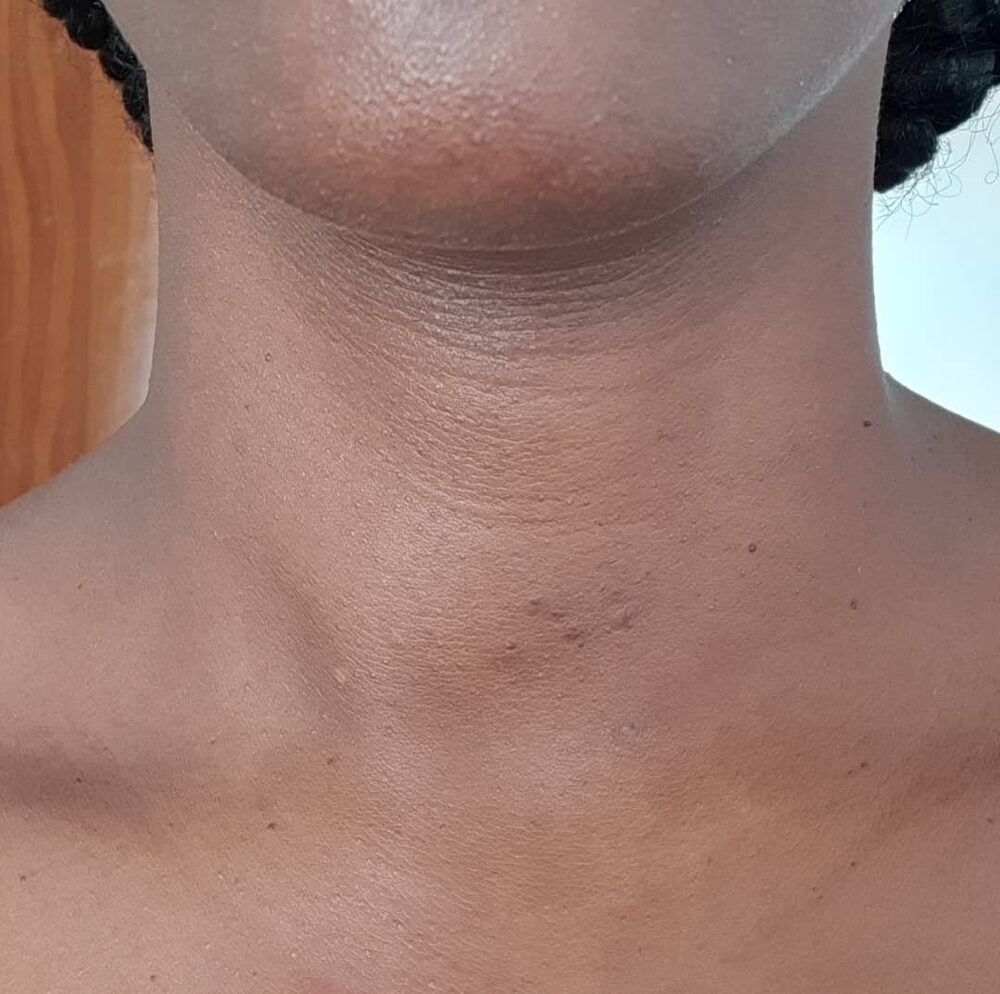
From a visible swelling to a flat neck in one month
Every photograph and result below was shared by the patient with her written consent, with her eyes and part of her face cropped for privacy. Individual results vary.
-
9 June 2026 · First consultation
Advised surgery elsewhere — looking for another way
She came to us having already been reviewed at several clinics around Nairobi, where she had been advised to undergo a partial thyroidectomy — surgical removal of the left lobe of her thyroid. She was reluctant to have an operation and wanted to understand her options. She had first noticed the neck swelling about six months earlier; she had no difficulty swallowing and no hoarseness, but was beginning to feel mild pressure, particularly when lying down.
-
9 June 2026 · Ultrasound findings
A large nodule replacing the left thyroid lobe
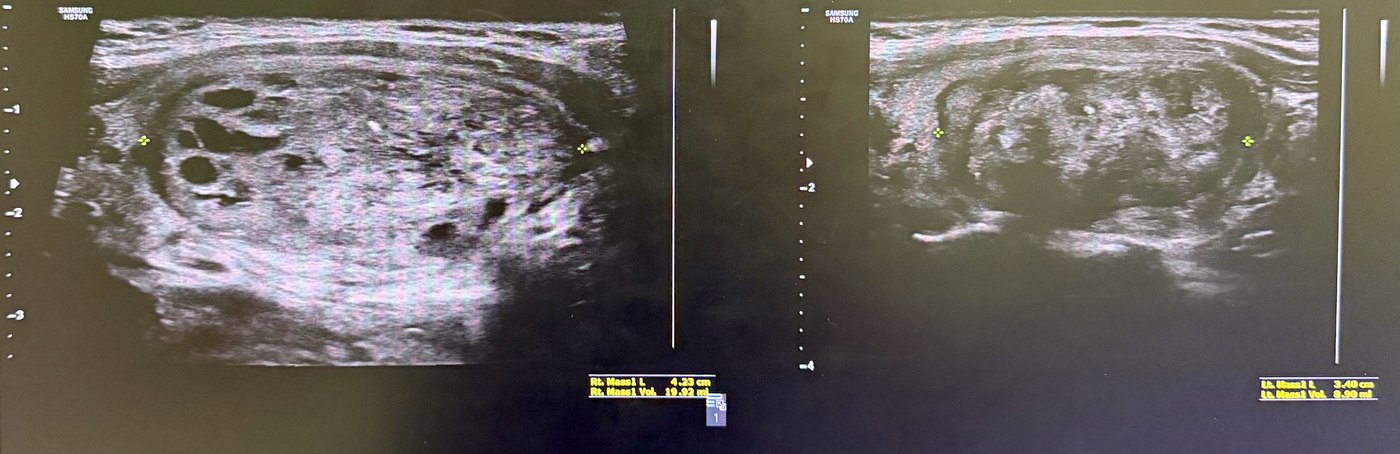
A detailed thyroid ultrasound showed a large nodule that occupied and effectively replaced the left thyroid lobe, with significant blood flow around it (perinodular vascularisation) and a volume of approximately 19 mL. Its size and position explained both the visible swelling and her pressure symptoms. The key question was whether it could be treated without removing the lobe.
-
27 June 2026 · Core needle biopsy
Confirming the nodule was benign first
Before considering RFA, it was essential to establish that the nodule was benign. A core needle biopsy was performed to obtain adequate tissue for diagnosis. RFA is used for appropriately selected benign nodules — it should never simply be used as a substitute for surgery without first confirming that the patient and the nodule are suitable. The findings supported a benign diagnosis, and she proceeded to treatment planning.
-
25 July 2026 · Procedure day
About an hour, awake, and home the same day
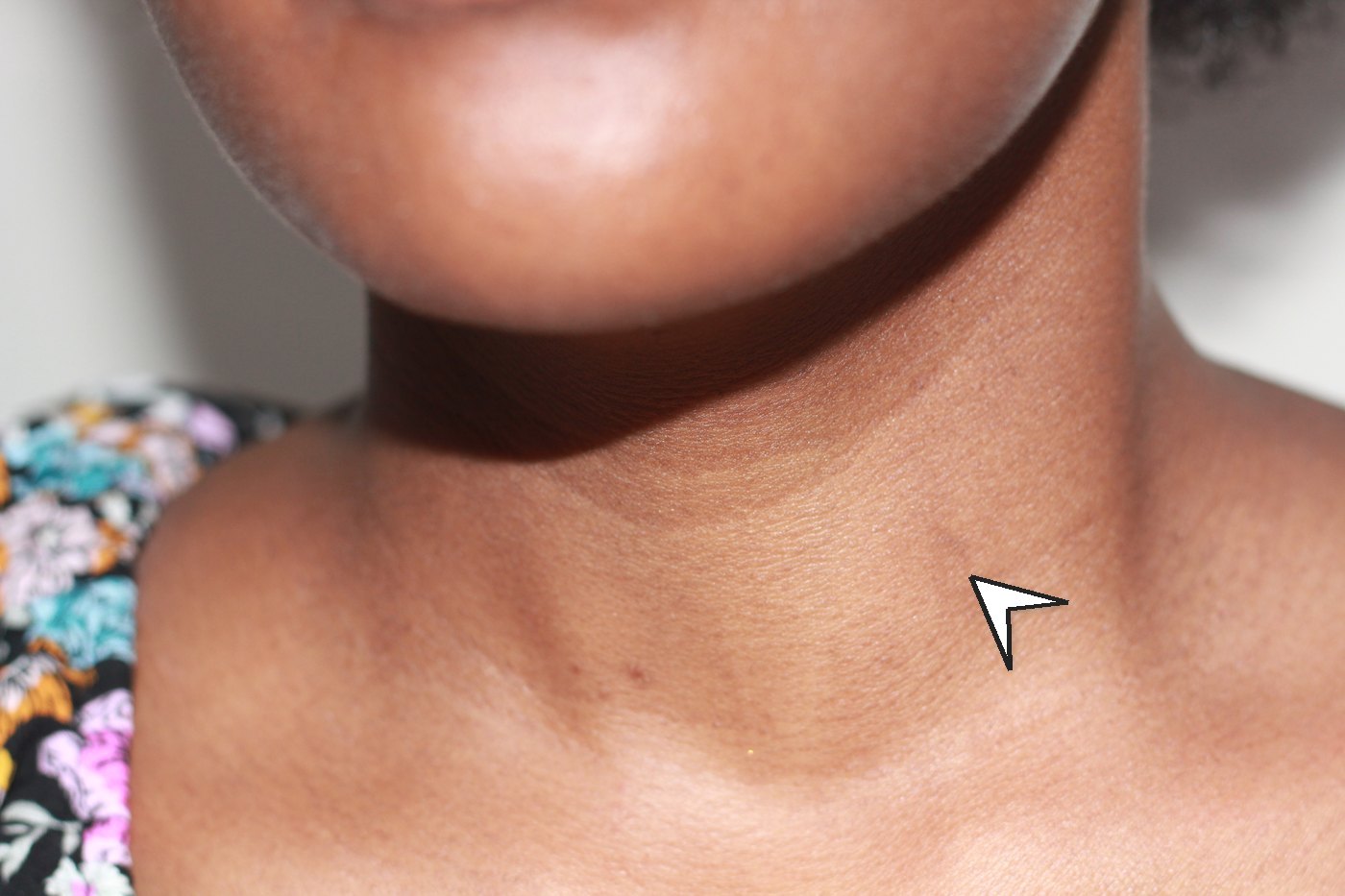
On the morning of treatment the swelling was clearly visible on the left side of her neck. She had ultrasound-guided radiofrequency ablation under local anaesthetic — awake and comfortable, with the procedure taking about an hour. It was completed safely with no major events, and she went home the same day. Throughout, we kept talking with her so we could continuously monitor her voice (see below).
-
28 August 2026 · One-month review
The visible swelling had gone
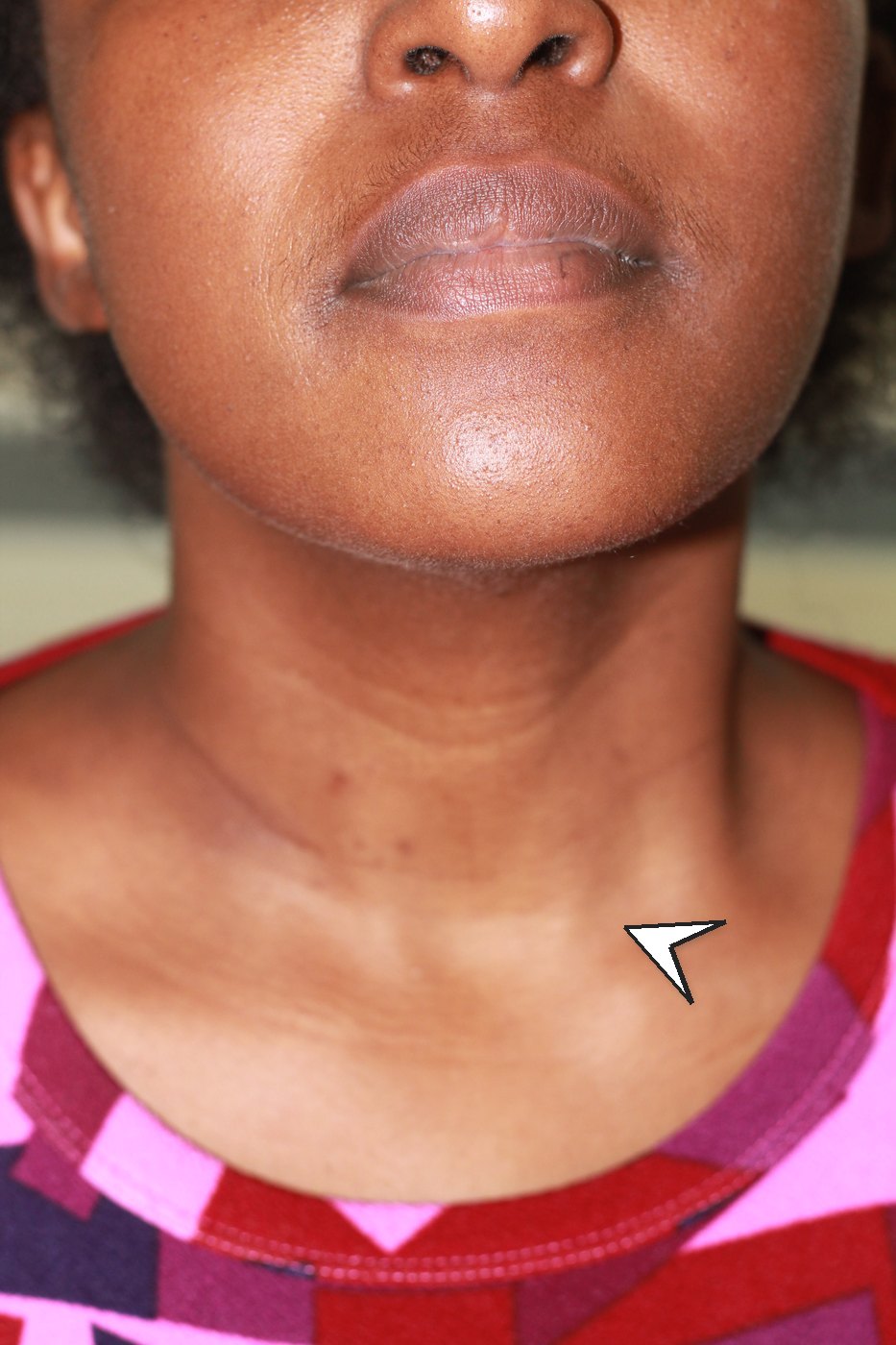
One month after the procedure the change was immediately apparent: the previously visible swelling in her neck was no longer visible. More importantly, the pressure symptoms she had felt before had resolved, she had no new voice symptoms, and she was extremely pleased with the outcome.
-
28 August 2026 · Follow-up ultrasound
A 54% volume reduction confirmed on ultrasound
A follow-up thyroid ultrasound measured the response objectively: a 54% volume reduction ratio (VRR) at one month — the nodule had reduced from roughly 19 mL to about 9 mL. This matched the visible improvement in her neck and the resolution of her pressure symptoms. Individual results vary, and benign nodules commonly continue to shrink over the months that follow.
-
Next · Three-month review
Monitoring the continued response
She has been scheduled for further follow-up at three months. A repeat thyroid ultrasound will monitor the continuing reduction in nodule volume, assess the treated area, review her symptoms and check her thyroid function where clinically appropriate — because benign nodules commonly keep reducing in volume for months after a successful thermal ablation.
About an hour, awake, and no scar
Under continuous ultrasound guidance and local anaesthetic, a fine electrode was placed into the nodule and controlled radiofrequency energy was used to heat and destroy the abnormal tissue, while the surrounding healthy thyroid was preserved. She stayed awake and comfortable, the visit took about an hour, and she went home the same day.
Over the following weeks the body gradually clears the treated tissue, so the nodule shrinks. See how RFA works, step by step →
Protecting the voice
The nerve that controls the vocal cords runs close to the thyroid. During RFA we keep talking with the patient, so that any change in the voice is an immediate warning sign.
Had her voice changed, treatment would have been paused at once and protective measures taken — for example, injecting a cool fluid around the area to reduce the heat. No such change occurred, and the procedure was completed safely.
Avoiding surgery doesn't mean avoiding proper treatment
Thyroid surgery is sometimes necessary — it is not automatically the best treatment for every nodule, and it is not automatically avoidable either. The right choice depends on the whole picture:
- Whether the nodule is benign or suspicious for cancer
- The size and location of the nodule
- Whether the nodule is causing pressure symptoms
- Whether there is a visible swelling or cosmetic concern
- The ultrasound characteristics of the nodule
- Previous biopsy findings
- The patient's thyroid function
- The patient's overall health and treatment preferences
- Whether the nodule is suitable for minimally invasive thermal ablation
For appropriately selected patients, RFA can reduce the size of a benign nodule without removing the thyroid. This may help selected patients avoid:
- A surgical incision in the neck
- Removal of part or all of the thyroid gland
- General anaesthesia associated with conventional surgery
- The recovery period that follows open thyroid surgery
- Some of the potential complications associated with thyroidectomy
But RFA is not suitable for every nodule, and surgery remains essential in many situations. The most important step is not simply choosing RFA versus a thyroidectomy — it is making sure the diagnosis is correct and the assessment is thorough. At Thyroid Care Kenya we assess each patient individually to decide whether conventional surgery or a minimally invasive option — such as radiofrequency ablation or microwave ablation — is more appropriate.
You may be a candidate for thyroid RFA if you have…
- A benign, biopsy-proven thyroid nodule
- A nodule causing a visible neck swelling or cosmetic concern
- Pressure symptoms such as tightness or discomfort when lying down
- A wish to preserve the thyroid and avoid a neck scar
- Suitability confirmed on your own ultrasound, biopsy and blood tests
Thyroid nodules, RFA and avoiding surgery
Yes. Some benign thyroid nodules can be treated without conventional surgery using minimally invasive procedures such as radiofrequency ablation (RFA). Suitability depends on the diagnosis, the ultrasound findings, the size and location of the nodule, the symptoms and other clinical factors — so it is decided case by case.
For selected patients with a confirmed benign nodule, RFA can be an alternative to removing part of the thyroid. It does not replace surgery in every situation — patients with suspected or confirmed thyroid cancer, or with otherwise unsuitable nodules, may still need an operation. The safest first step is a proper assessment, not simply choosing RFA over surgery.
The recurrent laryngeal nerve controls the vocal cords and runs close to the thyroid, so it is protected carefully during both surgery and thermal ablation. During RFA we keep talking with the patient, so any change in the voice gives an immediate warning; if that happened, treatment would be paused and protective measures taken, such as injecting cool fluid around the area to reduce the heat. In this case there was no voice change and the procedure was completed safely.
It varies between patients and nodules. In this case an ultrasound showed a 54% volume reduction one month after treatment. The body clears the treated tissue gradually, so the nodule usually keeps shrinking over the following months. Individual results vary and are confirmed at your review.
VRR is the standard way to measure how much a nodule has reduced after treatment — the percentage of the original volume that has gone. A 54% VRR at one month, as here, means just over half of the nodule's starting volume had already resolved.
Microwave ablation is another thermal ablation technique that can be used for selected thyroid nodules. Like RFA, whether it is appropriate depends on the characteristics of the individual nodule and the overall clinical assessment.
At Thyroid Care Kenya, thyroid RFA is carried out as part of a structured assessment pathway — thyroid ultrasound, confirmation that the nodule is benign, and the procedure itself — by Dr. Ebrahim Yusuf, a consultant physician and interventional endocrinologist in Nairobi.
Yes. If you have been diagnosed with a thyroid nodule and advised to have surgery, a specialist assessment can help you understand all the appropriate options. Send your recent thyroid ultrasound, any biopsy report and your blood tests on WhatsApp for a free reports review, and we will tell you honestly whether RFA or another approach may suit you.

Dr. Ebrahim Yusuf Ebrahim
Consultant Physician · Interventional Endocrinologist & Diabetologist
One of the first doctors in Kenya to bring minimally invasive thermal ablation — microwave and radiofrequency — to the treatment of thyroid nodules and goitre, sparing patients from surgery. He personally performs each assessment, thyroid ultrasound and RFA procedure — the same care this patient received.
- MMed, Internal Medicine — University of Nairobi
- PG Diploma, Endocrinology & Diabetes — Royal College of Physicians, Ireland
- Fellowship, Endocrinology & Diabetes — University of Alexandria, Egypt
- Certificate in Interventional Thyroidology — Mumbai, India
- Special focus: thermal ablation (RFA & microwave) for thyroid nodules
Keep reading
Thyroid RFA
How radiofrequency ablation shrinks a benign nodule — who it suits, and what to expect.
Read →
Thyroid nodules
How thyroid nodules are assessed, when they need treatment, and when they can be watched.
Read →
 BEFORE
 AFTER
AFTERMore patient stories
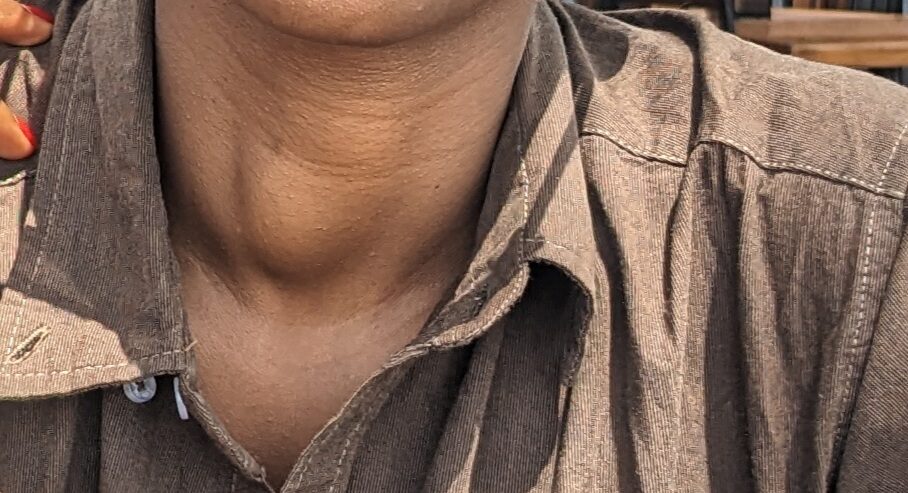
Real, consented before-and-after RFA results from patients treated in Nairobi.
Read →
Medically reviewed by Dr. Ebrahim Yusuf Ebrahim, Consultant Physician & Interventional Endocrinologist. Clinical figures are ranges from peer-reviewed studies, provided for general education — individual results vary and are confirmed at your review.
Patient images and clinical information are shared with the patient's written permission and anonymised. Individual results vary, and treatment recommendations are based on each patient's specific condition and clinical assessment.
References
- Kim JH, Baek JH, Lim HK, et al. 2017 Thyroid Radiofrequency Ablation Guideline: Korean Society of Thyroid Radiology. Korean Journal of Radiology, 2018;19(4).
- Papini E, Monpeyssen H, Frasoldati A, Hegedüs L. 2020 European Thyroid Association Clinical Practice Guideline for the Use of Image-Guided Ablation in Benign Thyroid Nodules. European Thyroid Journal, 2020;9(4).
Have you been told you need a thyroidectomy?
If you have a thyroid nodule and have been advised to have surgery, it may be worth a specialist assessment first. Send your thyroid ultrasound, any biopsy report and your blood tests on WhatsApp for a free, no-obligation review — and find out honestly whether RFA can help you.
