
Have you noticed a swelling in the front of your neck?
A goitre — an enlarged thyroid gland — is common and often treatable. Whether it causes discomfort, affects your appearance, or was found during a medical examination, our specialist clinic provides expert assessment, high-resolution thyroid ultrasound, accurate diagnosis and personalised treatment.
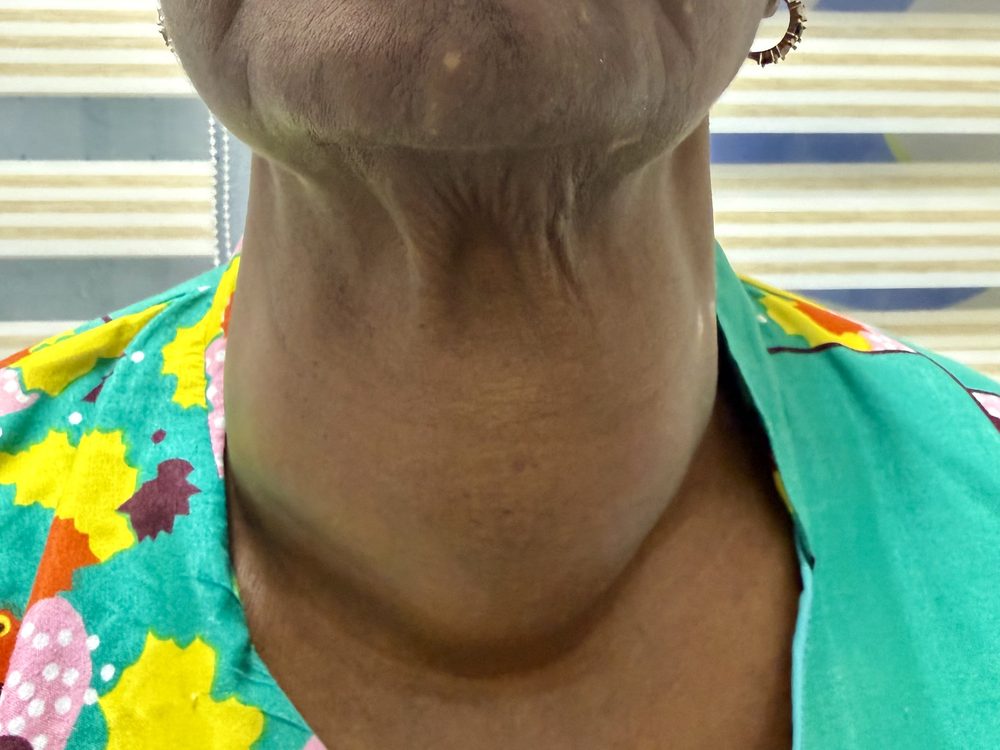
What is a goitre?
A goitre is an enlargement of the thyroid gland — the butterfly-shaped gland at the front of your neck. It is not a disease itself but a sign of an underlying thyroid condition. The enlargement may involve the whole gland or only part of it, and can occur with normal, overactive or underactive thyroid function.
Most goitres are benign, and many can be managed without surgery. Accurate diagnosis — specialist consultation, thyroid ultrasound and laboratory testing — is essential.
Worth knowing
Many people with a goitre have completely normal thyroid hormone levels. An enlarged thyroid does not automatically mean it is overactive or underactive.
What a goitre can feel like
Common signs
- Visible swelling in the front of the neck
- A feeling of fullness or tightness
- Difficulty swallowing
- Difficulty breathing (large goitres)
- Hoarseness
- A chronic cough
If it's overactive
- Weight loss
- Palpitations
- Sweating
- Tremor
- Anxiety
- Heat intolerance
If it's underactive
- Fatigue
- Weight gain
- Cold intolerance
- Dry skin
- Constipation
- Low mood
See a specialist promptly if you notice
- A rapidly enlarging swelling
- Persistent hoarseness
- Difficulty breathing
- Difficulty swallowing
- Enlarged lymph nodes
- A hard, fixed thyroid lump
Most goitres are not cancer — but the urgent symptoms above deserve prompt specialist assessment.
Why a thyroid enlarges
- Iodine deficiency
- Thyroid nodules
- Autoimmune thyroid disease (Hashimoto's and Graves')
- Thyroiditis
- Pregnancy
- Certain medications
- Thyroid cancer (less common)
Stress does not directly cause a goitre, but it may worsen the symptoms of existing thyroid disease.
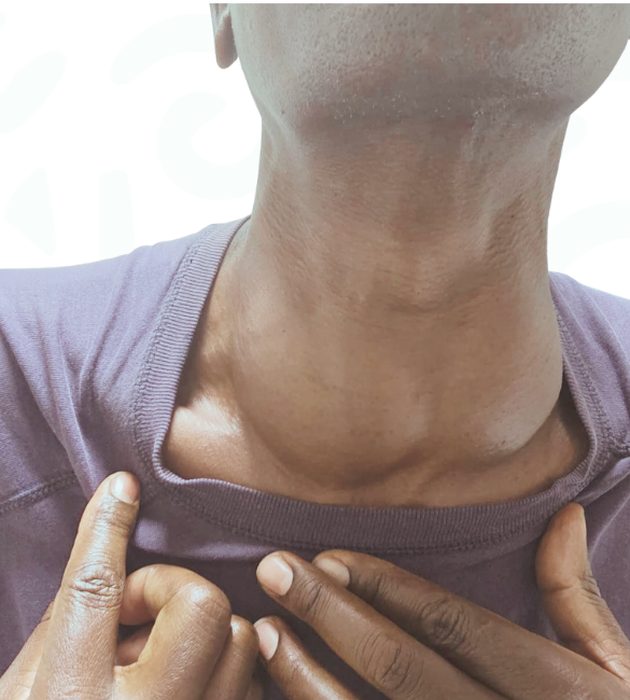
Six steps to a clear answer
Specialist consultation
Your story, your symptoms and a focused review with a consultant endocrinologist.
Physical examination
Careful examination of the thyroid and the lymph nodes of the neck.
Thyroid ultrasound
High-resolution scanning of the gland — size, nodules, blood flow and lymph nodes.
Thyroid blood tests
TSH, Free T4, Free T3 and thyroid antibodies (TPO, thyroglobulin, TRAb) where indicated.
Biopsy when indicated
Image-guided FNAC or core needle biopsy, only when the ultrasound findings call for it.
Personalised plan
A clear diagnosis and a treatment plan built around your goitre and your life.
Not every goitre is the same
“Goitre” describes the enlargement, not its cause — and the pattern of enlargement guides the assessment. Ultrasound tells these apart at your first visit, which is why every goitre begins with a careful scan.
Diffuse goitre
The whole gland is uniformly and smoothly enlarged, with no discrete lumps. Often physiological (puberty, pregnancy) or autoimmune — as in Graves' disease or Hashimoto's thyroiditis.
Multinodular goitre
The gland is enlarged and contains several nodules. This is the most common pattern in older adults, and the great majority are benign.
Solitary nodular goitre
A single dominant nodule enlarges the gland. It is assessed on ultrasound with ACR TI-RADS grading and, only when the features call for it, a biopsy.
Toxic multinodular goitre
A long-standing multinodular goitre in which one or more nodules become overactive and produce excess hormone. More on toxic multinodular goitre →
Retrosternal (substernal) goitre
The enlargement extends downward behind the breastbone into the chest. It is more likely to press on the windpipe or gullet, and CT or MRI helps map its full extent.
Endemic goitre
Caused by dietary iodine deficiency across a population. It is far less common where salt is iodised, but is still seen in some regions and responds to correcting the iodine intake.
The type points us toward the likely cause and the right next test — but a benign or malignant answer comes only from the full assessment: ultrasound features and, where indicated, a biopsy.
What your thyroid bloods add
Every goitre assessment includes simple thyroid blood tests. Many people with a goitre have completely normal thyroid function — but the results tell us whether the enlarged gland is affecting your hormone levels, and they guide what happens next.
A normal result is common and reassuring — it confirms the goitre is not making you over- or under-active. Where the numbers are abnormal, they point us toward the underlying cause rather than a reflex procedure.
What the results can flag
- TSH, free T4 and free T3 show whether the goitre is affecting your thyroid hormone levels
- Thyroid antibodies (TPO, thyroglobulin, TRAb) help identify autoimmune causes such as Hashimoto's or Graves'
- A low TSH can signal an overactive ('toxic') nodule within the goitre — the cue for an uptake scan
Crucially, normal blood tests do not exclude structural disease. Blood tests show how the thyroid is working; ultrasound shows how it is built — an enlarged gland still needs imaging even when the hormones are normal.
The cornerstone of goitre assessment
Thyroid ultrasound is the cornerstone of goitre assessment — painless, radiation-free and done in the clinic.
What it evaluates
- Thyroid size and volume
- Diffuse vs nodular enlargement
- Individual thyroid nodules
- ACR TI-RADS risk classification
- Blood flow patterns
- Cervical lymph nodes
Why it matters
- Early detection of nodules
- Accurate, same-visit diagnosis
- Better treatment planning
- Guidance for FNAC, core biopsy and RFA
A biopsy only when the scan calls for it
Most goitres never need a biopsy. When ultrasound shows a nodule with features that warrant a closer look, a small image-guided sample settles the question — safely, and usually in clinic.
- A nodule with suspicious ultrasound features on the ACR TI-RADS scale
- A nodule that reaches the size threshold for its risk grade
- A nodule that is growing, or enlarged lymph nodes in the neck
- A result that needs confirming before planning treatment
The sample is usually a fine needle aspiration (FNAC); a core needle biopsy is used when a larger tissue sample is needed. Both are ultrasound-guided for accuracy.
Treatment depends on the cause
Observation & monitoring
Many small, benign goitres simply need scheduled ultrasound follow-up — no treatment at all.
Medication
An underactive or overactive thyroid, or thyroiditis, is treated medically to restore normal function.
Radiofrequency ablation (RFA)
Selected benign nodules can be shrunk without surgery — no incision, no scar, home the same day.
Learn more →
Surgery — for selected patients
Reserved for cancer suspicion, severe compressive symptoms, or nodules unsuitable for RFA. We refer and guide you.
Living well with a goitre
A goitre is usually a long-term part of your health rather than a one-off problem — and most people live entirely normally with one. A few simple habits keep it that way.
- Keep your scheduled ultrasound and blood-test follow-ups, so any change is caught early
- Eat a balanced diet with adequate — but not excessive — iodine; iodised salt is usually enough
- Report any new pressure, swallowing or breathing symptoms, or rapid growth, without delay
- Take any prescribed thyroid medication consistently and attend your monitoring appointments
- Stay active; if your thyroid is overactive, have it controlled before strenuous exercise
- Avoid high-dose iodine supplements or kelp products unless your specialist advises them
The good news
If a goitre is stable, benign and causing no symptoms, “living well” may simply mean periodic monitoring — no treatment at all.
Refer a patient with a goitre
We welcome referrals from GPs, physicians and surgeons across Kenya and the wider region for the assessment and management of thyroid enlargement.
When to refer
Any new or enlarging goitre, a goitre with compressive symptoms (swallowing or breathing difficulty, hoarseness), an abnormal thyroid function test with a palpable gland, or a nodule that needs risk stratification.
What we provide
Consultant-led assessment, same-visit high-resolution ultrasound with ACR TI-RADS grading, image-guided FNAC and core needle biopsy, radiofrequency ablation for suitable benign nodules, and onward surgical referral when needed — with a clear written report back to you.
Care built around your thyroid
- Consultant endocrinologist with dedicated thyroid expertise
- In-clinic high-resolution thyroid ultrasound
- Evidence-based, guideline-driven care
- Access to advanced minimally invasive treatment (RFA)
- Comprehensive long-term follow-up
- Patient-centred, unhurried communication
How we care for you
Listen
Your story and symptoms, unhurried.
Investigate
Ultrasound, blood tests, biopsy when needed.
Personalise
A treatment plan built around you.
Support
Follow-up and access for the long term.
Goitre — your questions answered
Not quite. A goitre is enlargement of the thyroid gland as a whole; a nodule is a discrete lump within the gland. They often occur together — a nodular goitre — which is why both are assessed in the same ultrasound examination.
Usually not. The great majority of goitres are benign. A specialist assessment with ultrasound — and a biopsy only when indicated — is how we confidently rule cancer out.
Some do — particularly those related to thyroiditis or pregnancy, which can settle as the underlying cause resolves. Many persist, which is why monitoring matters.
Often, yes. Depending on the cause, options include observation, medication, and radiofrequency ablation (RFA) for selected benign nodules. Surgery is reserved for specific situations.
No. It is a painless, radiation-free scan using a small probe on the skin of your neck, and it typically takes about 15–20 minutes.
Only if your ultrasound shows features that warrant one. We follow the ACR TI-RADS classification, so a biopsy is recommended based on evidence — not by default.
A large goitre can press on the windpipe and cause breathlessness, especially when lying flat. Difficulty breathing with a neck swelling should always be assessed promptly.
Thyroid disease can run in families. If a parent or sibling has thyroid disease, your own likelihood is higher — worth mentioning at your consultation.
Pregnancy hormones can mildly enlarge the thyroid. This usually settles after delivery, but a swelling that persists or grows should be assessed.
Generally yes. If you have symptoms of an overactive thyroid — palpitations, tremor — get it assessed and controlled first before strenuous exercise.
No specific food shrinks an established goitre. Iodine balance matters for prevention, but treatment depends on the underlying cause — not diet alone.
It's individual. Depending on the findings, ultrasound follow-up is typically every 6–12 months — your specialist will set the right interval for you.
Medically reviewed by Dr. Ebrahim Yusuf Ebrahim, Consultant Physician & Interventional Endocrinologist. Clinical figures are ranges from peer-reviewed studies, provided for general education — individual results vary and are confirmed at your review.
Related services
Don't ignore a swelling in your neck
Early assessment identifies the cause and guides the most appropriate treatment. Book a consultation, or start the conversation on WhatsApp.
