
From Somalia to Nairobi: a goitre treated without surgery — safely
A man from Somalia came to Thyroid Care Kenya in Nairobi with a visible goitre (thyroid nodule) and diabetes that had been poorly controlled for years. We brought his blood sugar under control first, checked his thyroid function, confirmed the nodule was benign with two biopsy samples, and then treated it with radiofrequency ablation (RFA) under local anaesthetic — awake, comfortable and monitored throughout. No general anaesthetic, no incision, no scar.
“Can my neck swelling be treated without an operation?”
Patients from Somalia and Somaliland travel to Nairobi because thyroid radiofrequency ablation (RFA) — a way to shrink a benign goitre or thyroid nodule without removing the thyroid — is not yet available at home. This patient's story shows that the safest route to RFA is not always the fastest one.
He came to us for evaluation of a goitre and possible RFA. He had lived with diabetes for more than eight years, using a premixed insulin on and off; his blood sugar was not well controlled and he had lost a great deal of weight. No thyroid blood tests or other laboratory investigations had been done. Before anything was done to the nodule, his general health — and above all his blood sugar — needed attention.
His journey at a glance
- First visit — Travelled from Somalia for assessment of a neck swelling (goitre) and possible RFA.
- Same day — Poorly controlled diabetes found — insulin adjusted, full blood tests including thyroid function ordered.
- One week later — Blood sugars reviewed; fine needle aspiration (FNAC) and core needle biopsy taken.
- Procedure day — Radiofrequency ablation performed under local anaesthetic — awake, comfortable and monitored throughout.
- Next step — Follow-up ultrasound to measure how much the nodule shrinks — we will add his progress here.
Why we treated his diabetes before his thyroid
High blood sugar slows healing and increases the risk of infection after any procedure. So the plan started with his diabetes — the thyroid could wait a week.
Step 1 · Control the blood sugar
His insulin was changed to a basal-bolus regimen — a once-daily long-acting insulin plus rapid-acting insulin with meals — with home glucose readings to guide adjustments.
Step 2 · Run the missing tests
Full blood tests, including thyroid function tests (TSH and thyroid hormones), had never been done. Weight loss can come from uncontrolled diabetes or from an overactive thyroid, so both needed checking.
Step 3 · Review in one week
Once his sugars had improved, we took two biopsy samples from the nodule and then planned the ablation — never the other way round.
From assessment to radiofrequency ablation
Every photograph below is shared with the patient's written consent. His face and the patient details on the ultrasound screen have been hidden for privacy. Individual results vary.
-
First visit · Assessment
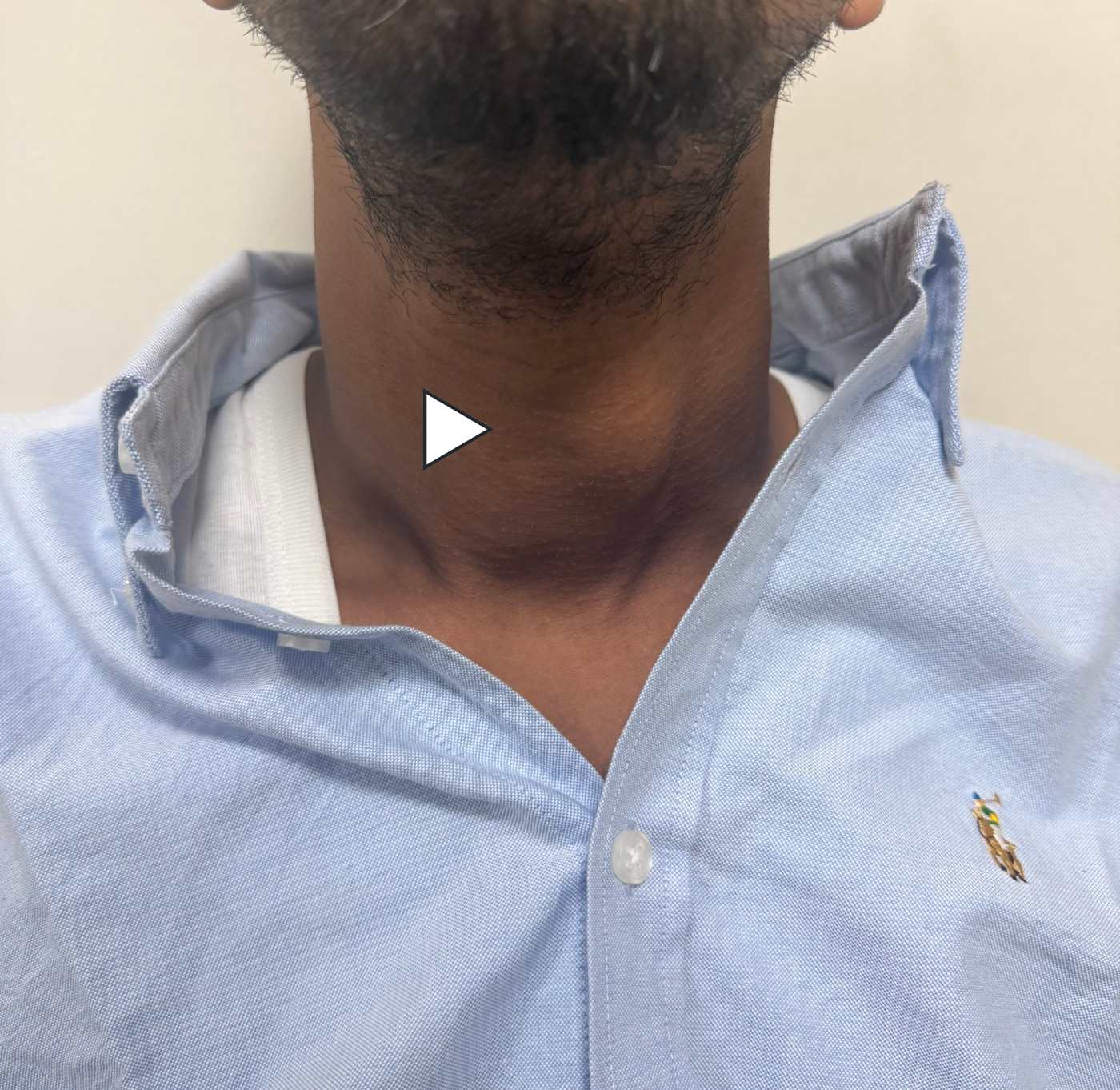
A neck swelling — and diabetes that wasn't under control
He travelled from Somalia to Nairobi for a specialist assessment of a swelling at the front of his neck and to find out whether it could be treated with radiofrequency ablation (RFA) instead of surgery. He had been living with diabetes for more than eight years, using a premixed insulin on and off. His blood sugar was poorly controlled and he had lost a great deal of weight. He had never had thyroid blood tests or other laboratory investigations for the swelling.
-
First visit · The plan
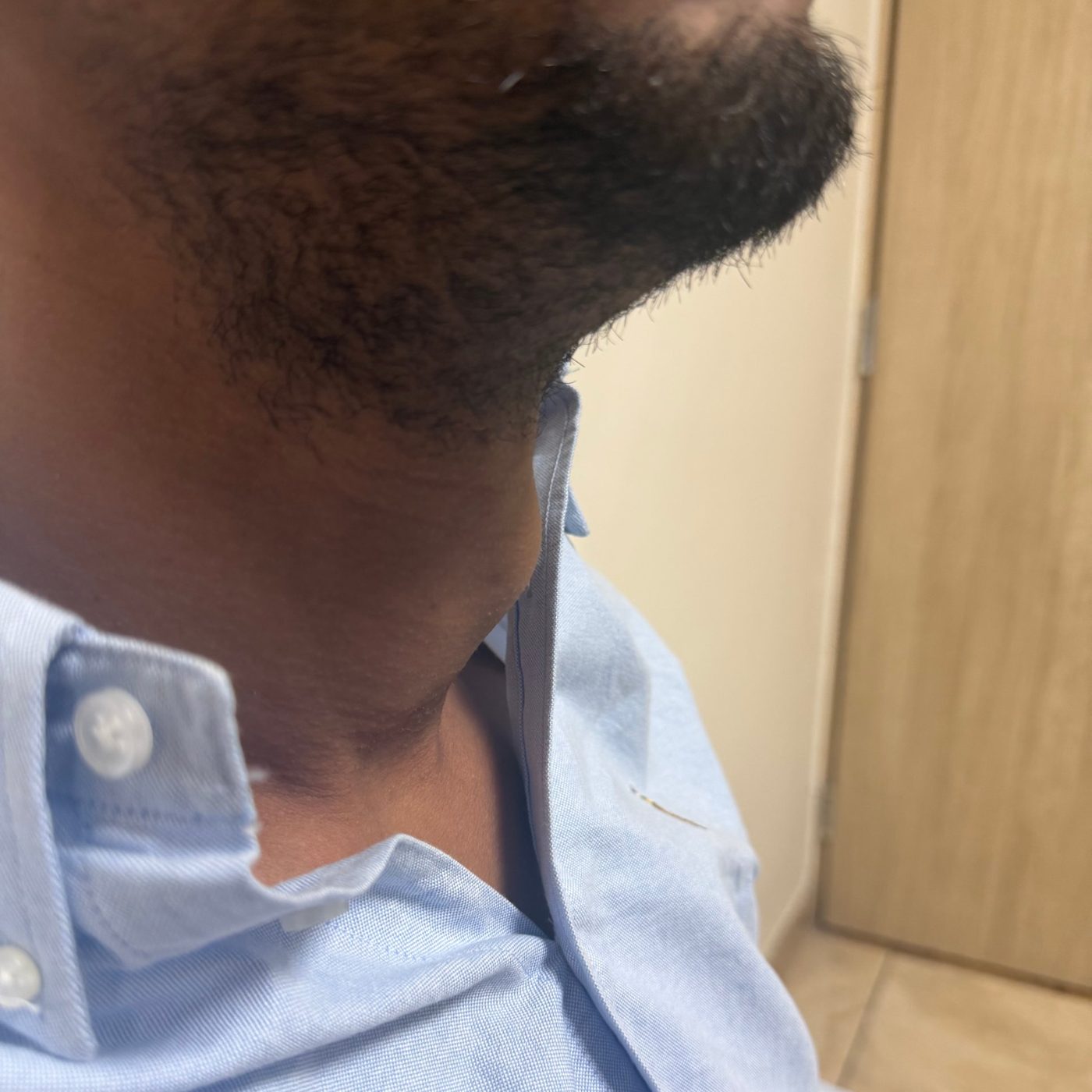
Safety first: control the blood sugar before any needle
Treating the neck swelling had to wait — briefly. High blood sugar slows healing and raises the risk of infection, so we optimised his diabetes first, moving him to a basal-bolus insulin regimen (a long-acting insulin once a day plus a rapid-acting insulin with meals). We requested full blood tests, including thyroid function tests — unexplained weight loss can also be a sign of an overactive thyroid, so this could not be assumed. He was asked to record his blood sugars and return in one week.
-
One week later · Biopsy
Two samples to confirm the nodule was benign
With his blood sugars improving, we reviewed his readings and blood results and took tissue from the nodule. We performed a core needle biopsy in addition to fine needle aspiration (FNAC), because we require at least two benign samples — FNAC or core needle biopsy — before offering a minimally invasive treatment such as RFA. This follows international RFA guidelines and protects patients from having a cancer treated as if it were benign.
-
Procedure day · Radiofrequency ablation
Awake, comfortable and monitored throughout
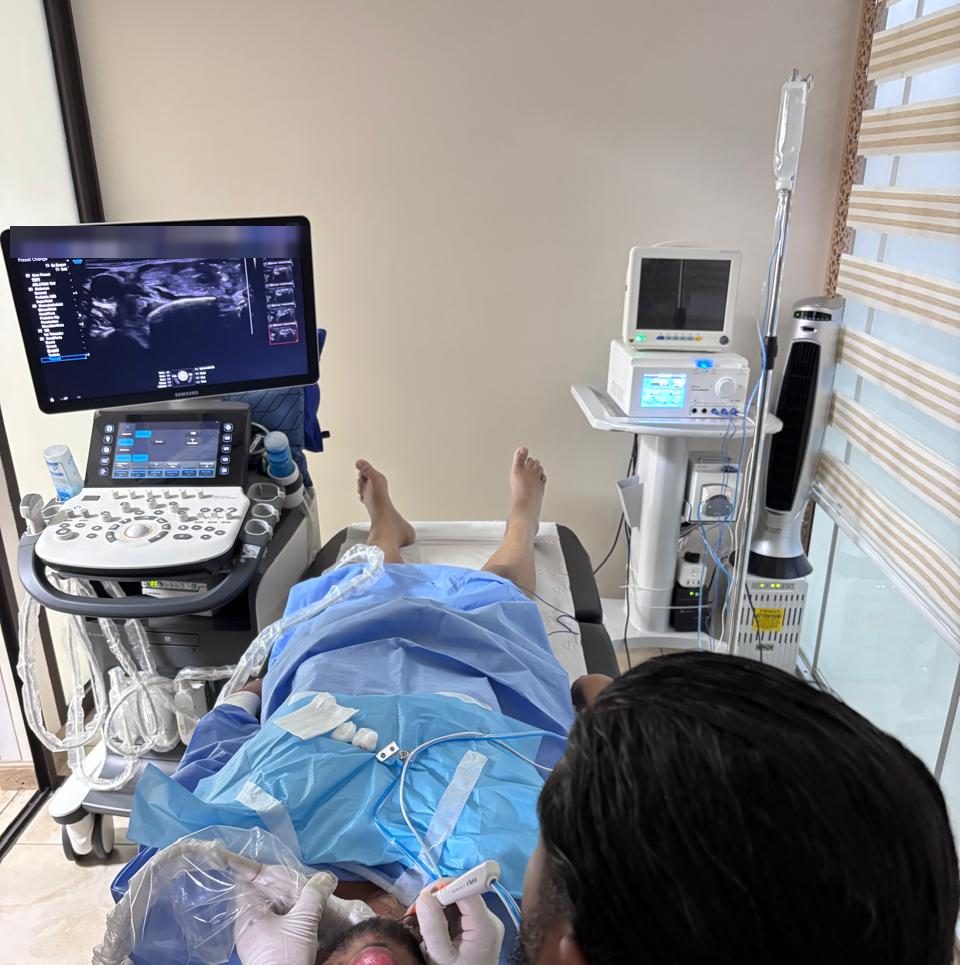
The ablation was performed under local anaesthetic. As the photograph shows, he lay comfortably on the couch while Dr. Ebrahim Yusuf watched the position of the needle continuously on the ultrasound screen ahead of him. We deliberately did not put him to sleep: keeping him awake let us check his voice throughout the procedure, while his heart rate and comfort were monitored at every stage. This is a key part of what makes thyroid RFA safe.
-
Procedure day · Afterwards
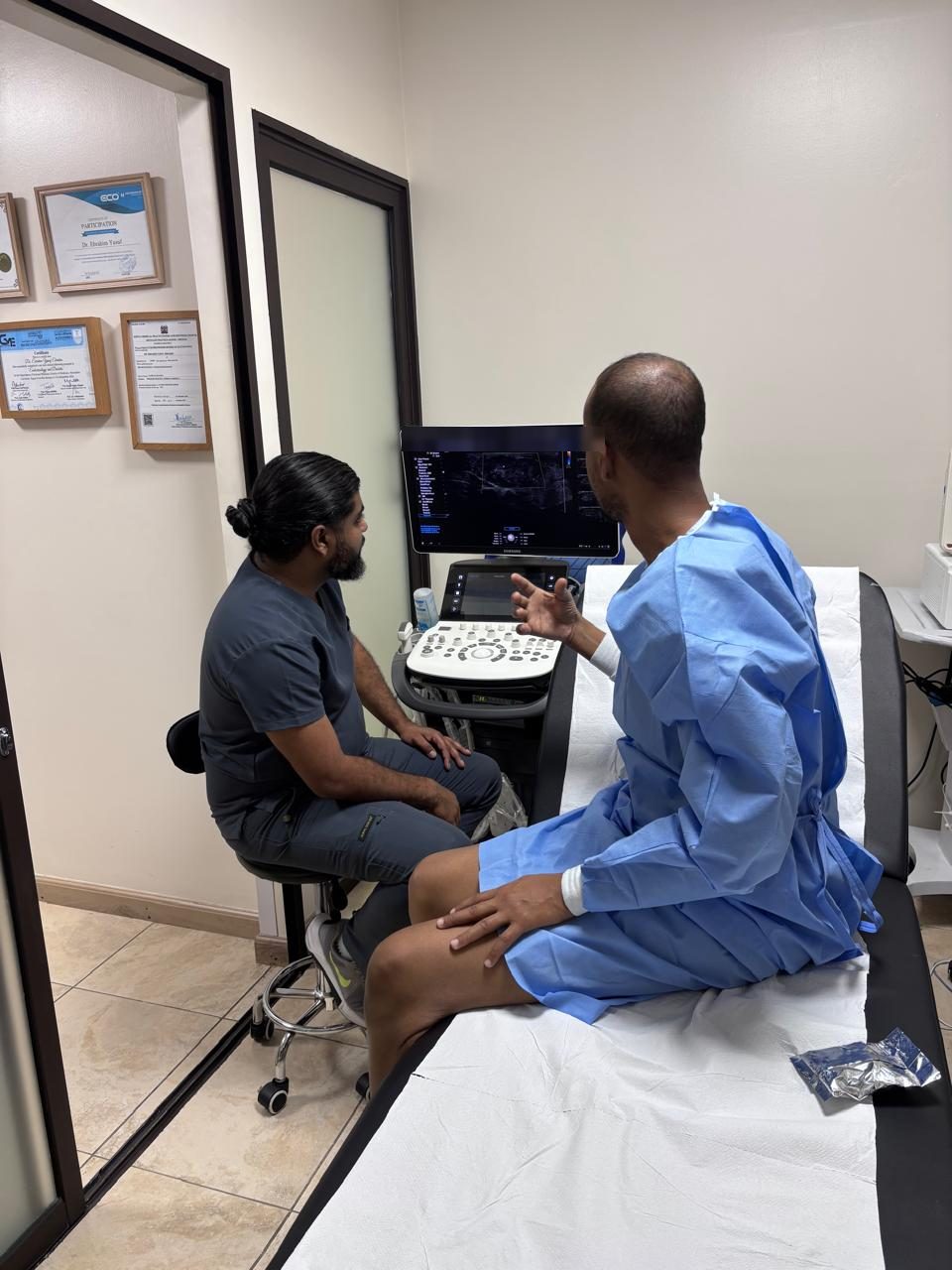
Talking it through together
Straight after the procedure he was sitting up and talking with us. We went through the ultrasound images together — what had been treated, what to expect in the days ahead, and how the nodule is expected to shrink gradually over the coming months as the body clears the treated tissue.
-
Next · Follow-up
Measuring the response — progress to follow
Follow-up ultrasound will measure the nodule's volume and the change in his neck swelling over time, alongside continued diabetes care. We will update this page with his progress as the results come in. Individual results vary, and benign nodules typically shrink gradually over several months after RFA.
Awake, comfortable — and that's deliberate
Under continuous ultrasound guidance and local anaesthetic, a fine electrode was placed into the nodule and controlled radiofrequency energy heated and destroyed the abnormal tissue, while the healthy thyroid around it was preserved. Dr. Ebrahim Yusuf followed the needle tip on the ultrasound screen at every moment.
We did not put him to sleep. General anaesthesia would have removed our most important real-time safety check — his voice. See how thyroid RFA works, step by step →
What we monitor while you're awake
- His voice — any change is an immediate warning sign near the nerve to the vocal cords
- His heart rate — watched continuously on the monitor
- His comfort and pain — so more local anaesthetic can be given at once if needed
- Real-time ultrasound of the needle tip throughout
If anything changes, treatment is paused at once and protective measures taken.
Two biopsy samples before any ablation
RFA is only for benign (non-cancerous) nodules. Before offering it, we require at least two benign samples — fine needle aspiration (FNAC) or core needle biopsy. For this patient we took both at the same visit, once his blood sugar had improved.
This is in line with international guidance from the Korean Society of Thyroid Radiology and the European Thyroid Association, and it is why we never treat a nodule with RFA on ultrasound appearance alone. Where a nodule is suspicious or cancerous, thyroid surgery remains the right treatment.
You may be a candidate for thyroid RFA if you have…
- A benign, biopsy-proven thyroid nodule
- A nodule causing a visible neck swelling or cosmetic concern
- Pressure symptoms such as tightness or discomfort when lying down
- A wish to preserve the thyroid and avoid a neck scar
- Suitability confirmed on your own ultrasound, biopsy and blood tests
Travelling from Somalia or Somaliland?
- Consultations available in Somali, English and Kiswahili
- Send your ultrasound, biopsy and blood tests first — we review them before you travel
- Most patients need a single 2–3 day visit to Nairobi
- If you have diabetes or another condition that needs preparing, we tell you in advance so you can plan a longer stay
Goitre, diabetes and thyroid RFA
Usually, yes — but your blood sugar should be reasonably well controlled first. High blood sugar slows healing and raises the risk of infection after any procedure. In this case we adjusted the patient's insulin, reviewed his readings after a week, and only then went ahead with biopsy and RFA. If you have diabetes, send us your recent sugar readings or HbA1c along with your thyroid reports.
RFA is only for benign (non-cancerous) nodules, so the diagnosis has to be secure. International RFA guidelines recommend at least two benign results — from fine needle aspiration (FNAC), core needle biopsy, or both — before ablation. Here we took both an FNAC and a core needle biopsy.
Staying awake is a safety feature. The nerve that controls the vocal cords runs close to the thyroid, so we talk with you throughout and listen for any change in your voice. We also watch your heart rate and ask about pain, adjusting the local anaesthetic straight away if needed. Under general anaesthesia that real-time check is lost.
Yes. Thyroid function tests show whether the gland — or the nodule — is overactive, underactive or normal, which affects the plan. This patient had never had them; weight loss can be caused by uncontrolled diabetes or by an overactive thyroid, so it was essential to check.
Gradually. The body clears the treated tissue over weeks and months, and published studies report that benign nodules commonly reduce by around half within six months, with further shrinkage over the following years. Individual results vary and are measured on follow-up ultrasound.
Send your thyroid ultrasound, any biopsy reports and your blood tests on WhatsApp for a free review first. Consultations are available in Somali. Most patients complete treatment in a single 2–3 day visit to Nairobi; if extra preparation is needed — such as getting diabetes under control, as in this case — we tell you before you travel so you can plan a longer stay. See our Somalia and Somaliland patient pages.
Not always. Many benign goitres and nodules that cause a visible swelling or pressure can be shrunk with RFA, while the thyroid is preserved. Surgery is still recommended for cancer, suspicious nodules and some very large goitres extending into the chest — which is why a full assessment comes first.
Send your recent thyroid ultrasound, any biopsy report and your thyroid blood tests on WhatsApp or through our reports form. A specialist will tell you honestly whether RFA suits you, and you receive a clear written quote with no obligation.
Dr. Ebrahim Yusuf Ebrahim
Consultant Physician · Interventional Endocrinologist & Diabetologist
One of the first doctors in Kenya to bring minimally invasive thermal ablation — microwave and radiofrequency — to the treatment of thyroid nodules and goitre, sparing patients from surgery. As an endocrinologist he manages diabetes and thyroid disease together — which is exactly what this patient needed — and personally performs each assessment, biopsy and RFA procedure.
- MMed, Internal Medicine — University of Nairobi
- PG Diploma, Endocrinology & Diabetes — Royal College of Physicians, Ireland
- Fellowship, Endocrinology & Diabetes — University of Alexandria, Egypt
- Certificate in Interventional Thyroidology — Mumbai, India
- Special focus: thermal ablation (RFA & microwave) for thyroid nodules
Keep reading
Thyroid RFA
How radiofrequency ablation shrinks a benign nodule or goitre — who it suits, and what to expect.
Read →
Patients from Somalia
Send your reports first, consult in Somali, and complete treatment in one short visit to Nairobi.
Read →
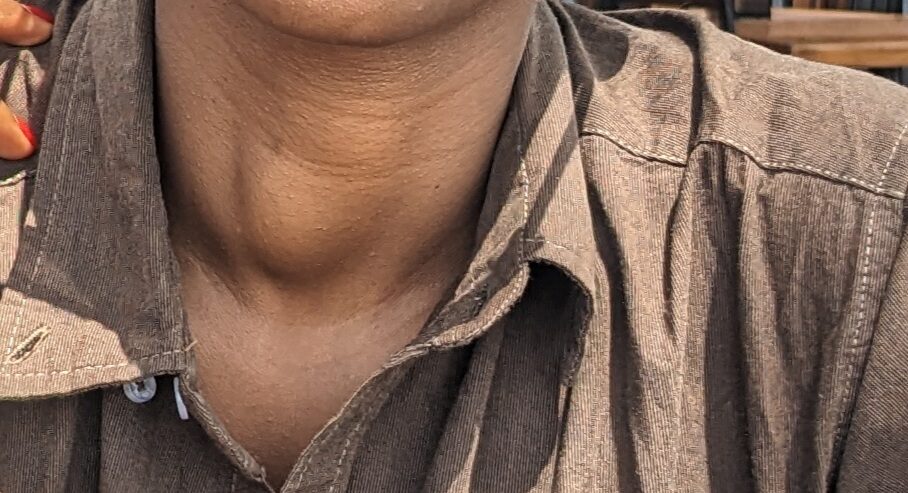 BEFORE
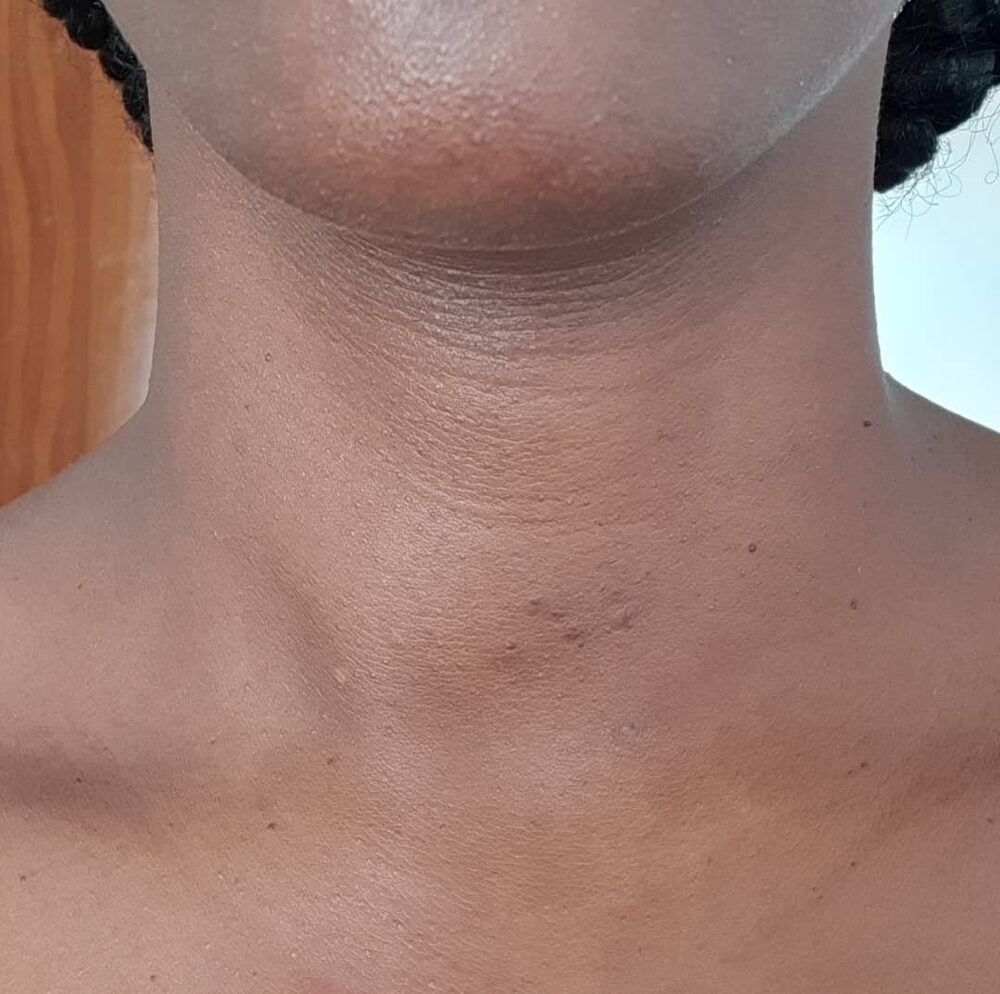 AFTER
AFTERMore patient stories
Real, consented before-and-after RFA results from patients treated in Nairobi.
Read →
Medically reviewed by Dr. Ebrahim Yusuf Ebrahim, Consultant Physician & Interventional Endocrinologist. Clinical figures are ranges from peer-reviewed studies, provided for general education — individual results vary and are confirmed at your review.
Patient images and clinical information are shared with the patient's written permission and anonymised. This is a progress report — follow-up results will be added as they become available. Individual results vary, and treatment recommendations are based on each patient's specific condition and clinical assessment.
References
- Kim JH, Baek JH, Lim HK, et al. 2017 Thyroid Radiofrequency Ablation Guideline: Korean Society of Thyroid Radiology. Korean Journal of Radiology, 2018;19(4).
- Papini E, Monpeyssen H, Frasoldati A, Hegedüs L. 2020 European Thyroid Association Clinical Practice Guideline for the Use of Image-Guided Ablation in Benign Thyroid Nodules. European Thyroid Journal, 2020;9(4).
- American Diabetes Association Professional Practice Committee. Diabetes Care in the Hospital (perioperative glycaemic management). Standards of Care in Diabetes. Diabetes Care (current edition).
Travelling from Somalia for thyroid treatment?
Send your thyroid ultrasound, any biopsy report and your blood tests — and your sugar readings if you have diabetes — for a free, no-obligation review. We'll tell you honestly whether RFA can help, and how long to plan to stay in Nairobi.
